A client’s birthday is one of the few moments you can reach out with nothing to sell. A short, well-judged message tells them you see a person, not an invoice.
The hard part is tone. Too stiff, and it reads like a form letter. Too friendly, and it crosses a line. The best professional birthday wishes for clients sit in the middle: warm, specific, and brief.
Below you’ll find messages sorted by relationship, industry, and channel. You’ll also find the timing, privacy, and etiquette questions most lists skip. Start with the ready-to-send messages in the first section, then browse ahead for your exact situation.
| Key Takeaways • A strong client birthday message has three parts: the client’s name, one real detail about your work together, and a wish with no ask attached. • One to three sentences is enough. Leave out age, appearance, health, and relationship status. • If you include an offer, send it as a separate message a few days apart from the greeting. • Match warmth to the relationship. A first-year client and a ten-year key account should not get the same message. |
Professional Birthday Wishes for Clients You Can Send Today
These 15 messages work for most clients. Replace the bracketed parts with real details, and sign with your own name. If a line doesn’t sound like something you’d say, change it.
1. The simple, safe greeting:“Happy birthday, [First name]. Wishing you a great day and a year that goes the way you want it to. — [Your name]”
2. Thanks first:“Happy birthday, [First name]! Thank you for trusting us with [project or work]. I hope today gives you a good reason to step away from your inbox.”
3. From the whole team:“Everyone at [Company] is wishing you a happy birthday. We hope the day is a good one.”
4. Quietly formal:“Please accept our best wishes on your birthday. It is a pleasure to work with you.”
5. Looking back on the year:“Happy birthday, [First name]. It’s been a good year working together, and I’m looking forward to the next one.”
6. Permission to switch off:“Happy birthday! I hope you get some time today that has nothing to do with work.”
7. After a busy stretch:“Happy birthday, [First name]. After a hectic [quarter or season], I hope today is a slower one.”
8. Recognizing their growth:“Happy birthday. Watching your team grow this year has been a pleasure, and I hope the year ahead is even better.”
9. For a handwritten card:“Wishing you a very happy birthday, [First name]. With warm regards, [Your name]”
10. Light and friendly:“Happy birthday, [First name]! I hope there’s cake today, and I hope it isn’t in a meeting.”
11. Valuing the relationship:“Happy birthday. I value the way we work together, and I hope your year brings more good news than you expect.”
12. No agenda:“Happy birthday, [First name]. Nothing to discuss today, just a sincere wish for a good one.”
13. Warm without getting personal:“Wishing you a happy birthday and a year of good company and good moments.”
14. Business-minded:“Happy birthday, [First name]. Here’s to a year of good decisions and better-than-planned results.”
15. From a senior contact:“Happy birthday, [First name]. On behalf of everyone at [Company], thank you for the confidence you’ve placed in us. I hope your day is a great one. — [Your name], [Title]”
Any of these works as a text, an email, or a card line. Adding one true detail, such as a shared project or a recent win, makes it feel much less like a template. The next section shows how.
How to Write a Client Birthday Message: The Name–Nod–Wish Formula
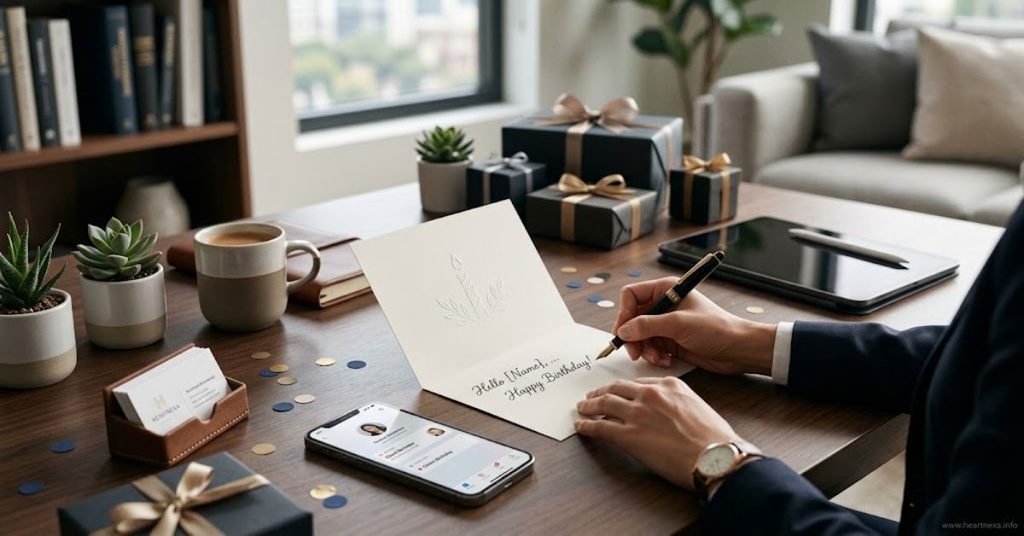
Most client birthday messages fail in one of two ways. They are so generic that any client could receive them, or they are so personal that the client feels watched. The Name–Nod–Wish formula avoids both. It has three parts, and none of them takes more than a sentence.
The Three Parts
Name. Address the client the way they address you. If they sign emails “Dana,” write “Dana.” If they use a title, keep it. In the UK and much of Europe, stay formal until the client has clearly moved to first names. Check the spelling, because a misspelled name in a greeting is worse than no greeting.
Nod. Add one true detail about your working relationship, such as a project you finished, a launch they led, or a problem you solved together. This single detail turns a template into a message. Draw it only from your shared work or from things the client has said openly. Health, family, age, finances, and appearance are not nods. They are assumptions.
Wish. End with a forward-looking wish about them, not about you. Leave out anything that asks for something: a review, a referral, a meeting, or “more years of business.” If the message contains an ask, it stops being a birthday wish.
Tone Dial: From Formal to Friendly
Choose the setting that matches the relationship, not the one you’d like to have.
| Level | Best for | Sign-off | Sample message |
| 1. Formal | New clients, senior executives, regulated industries | Kind regards / Sincerely | “Please accept my best wishes on your birthday. It is a privilege to work with you.” |
| 2. Polished and warm | Most ongoing clients | Best wishes / Warm regards | “Happy birthday, Mr. Alvarez. Thank you for a productive year, and I hope today is a pleasant one.” |
| 3. Friendly | Long-term clients who use first names and casual language | Best / Warmly | “Happy birthday, Dana! I hope the day has good coffee and no fires to put out.” |
| 4. Familiar | Clients you know well socially | Cheers / Take care | “Happy birthday, Dana. Go enjoy it, and I’ll see you next week.” |
If you’re unsure between two levels, pick the more formal one. A message that’s slightly too polished is forgotten by tomorrow. One that’s slightly too casual can stay with the client for a while.
Before and After: Rewriting a Generic Message
Each pair below shows the same greeting before and after applying the formula.
Generic email:
“Wishing you a very happy birthday filled with joy, prosperity, and success.”
With Name–Nod–Wish:
“Happy birthday, Priya. Getting your rebrand launched on time was the highlight of our year, and I hope this one brings you a well-earned pause.”
Generic text:
“Happy birthday from all of us at the firm!”
With Name–Nod–Wish:
“Happy birthday, Marcus! It’s been a pleasure helping with the office move this year. Enjoy your day.”
Generic card:
“Best wishes on your special day from your friends at the agency.”
With Name–Nod–Wish:
“Dear Ms. Okafor, best wishes on your birthday. Thank you for the trust you showed us on the summer campaign. I hope the year ahead is a rewarding one.”
Before sending, run a two-question check. First, could this exact message go to any of my clients? If yes, add a nod. Second, would it sound natural if I said it to them in person? If it wouldn’t, simplify the wording.
Formal Birthday Wishes for Clients
A formal birthday message is short, courteous, and free of jokes and hype. It suits new clients, senior contacts, and industries such as law, finance, and government work. Formal does not have to mean cold. The warmth comes from being specific and sincere, not from adding exclamation marks.
A few habits keep formal messages from sounding stiff:
• Use “Dear” plus the client’s title and surname unless they’ve invited first names.
• Keep it to two or three sentences.
• Add “no reply is necessary” when the client is very busy. It removes any sense of obligation.
Formal Email Greetings
For email, the subject line matters as much as the body. Keep it plain so it isn’t mistaken for a promotion.
1. The brief classic
Subject: Best wishes on your birthday
Dear [Mr./Ms. Surname], please accept my warmest wishes on your birthday. It is a pleasure to work with you. Kind regards, [Your name]
2. The year in review
Subject: Wishing you a happy birthday
Dear [Title Surname], as you celebrate your birthday, I want to thank you for a productive year working together. I hope the day brings you some well-earned time to relax. Sincerely, [Your name]
3. On behalf of the firm
Subject: Birthday wishes from [Firm name]
Dear [Title Surname], everyone at [Firm name] joins me in wishing you a very happy birthday. We value the trust you place in our team. Best regards, [Your name], [Title]
4. After a long engagement
Subject: A birthday note from [Company]
Dear [Title Surname], after [X months/years] of working together, it is a real pleasure to send you our best wishes on your birthday. Thank you for your confidence in our work.
5. The first birthday as a client
Subject: Happy birthday, [Title Surname]
Dear [Title Surname], although we have only recently begun working together, I wanted to send my best wishes on your birthday. We look forward to the year ahead.
6. Gratitude for their trust
Subject: With thanks and best wishes
Dear [Title Surname], on your birthday, I would like to express my sincere thanks for the trust you have placed in us. I hope the day is a pleasant one.
7. Recognizing their professionalism
Subject: Happy birthday from [Company]
Dear [Title Surname], working with you has been consistently straightforward and rewarding, and I am grateful for it. Please accept our best wishes on your birthday.
8. No reply needed
Subject: Birthday wishes
Dear [Title Surname], a short note to wish you a happy birthday. Please don’t feel you need to reply. I hope you enjoy the day. Warm regards, [Your name]
Formal Card Messages
Cards have less room, so every word counts. These fit a standard greeting card, and a handwritten signature adds a lot.
1. The classic:“Dear [Title Surname], with best wishes on your birthday. — [Your name]”
2. Team-signed:“Warmest birthday wishes from all of us at [Company]. We are grateful for your partnership.”
3. Short and handwritten:“Wishing you a happy birthday and a pleasant year ahead. With kind regards, [Your name]”
4. Partnership-focused:“On your birthday, we send our sincere thanks for a valued working relationship, and our best wishes for the year to come.”
5. For a long-standing contact:“Dear [Title Surname], it has been a privilege to work with you over the years. Please accept our warmest wishes on your birthday.”
6. The multiple-signature card:“Happy birthday from the whole team. It’s always a pleasure working with you.” (Have each colleague add a personal line.)
7. UK-style:“With very best wishes for your birthday, and with thanks for your continued custom. Kind regards, [Your name]”
8. From the managing partner:“Dear [Title Surname], on behalf of the partners and staff at [Firm], I send you our very best wishes on your birthday. — [Your name], Managing Partner”
Messages for Senior Executives and Board-Level Clients
Senior clients receive many messages, and most of them are long. A short, specific note stands out. Address them as they’d expect, and avoid anything that sounds like a sales touchpoint.
1. Peer to peer (CEO to CEO):“Dear [First name], warm birthday wishes from one leader to another. I’ve valued our conversations this year and hope the coming one is a rewarding one.”
2. From an account director:“Dear [Title Surname], on behalf of the [Company] team, I wish you a very happy birthday. We’re grateful for the opportunity to support [Client company].”
3. To a board chair:“Dear [Title Surname], please accept my respectful best wishes on your birthday. It is an honor to serve [Organization].”
4. To a founder:“Happy birthday, [First name]. Watching [Client company] grow has been a highlight of our year. I hope today gives you a moment to enjoy what you’ve built.”
Formal messages are only one register. Many long-standing clients would welcome something warmer, so the next section covers messages that thank them while still keeping a professional tone.
Warm Birthday Messages That Thank Your Clients
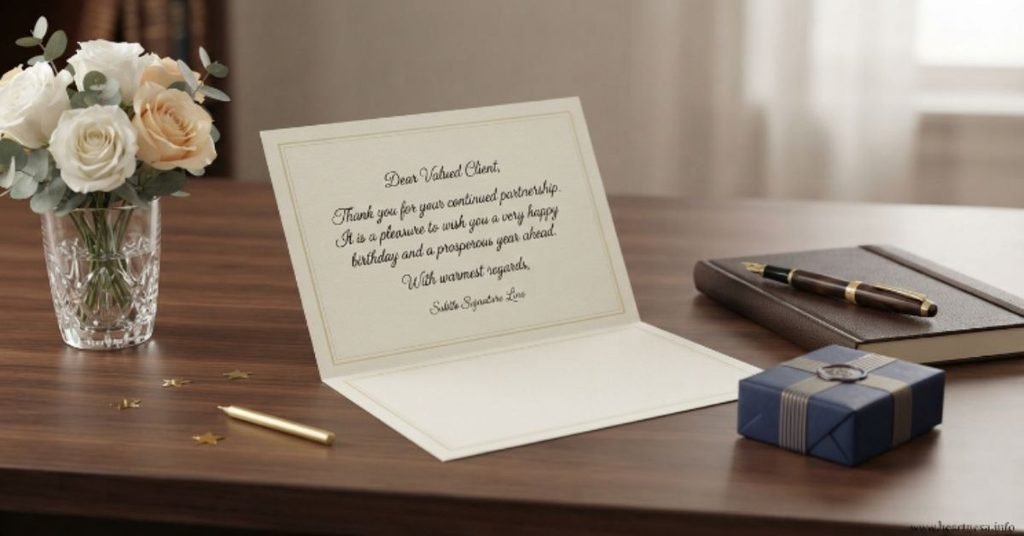
Warm does not mean personal. A warm message says thank you and means it, then stops. The client should finish reading it feeling appreciated, not obligated.
Two rules keep gratitude from turning awkward. Thank them for something real, such as their trust, their patience, or their feedback, rather than for “your business.” And never tie the thanks to what they’ve spent. Clients notice the difference immediately.
Gratitude-Led Messages
These lead with thanks and keep the birthday wish short.
1. For their trust:“Happy birthday, [First name]. Thank you for trusting us with [the work]. It means more than a contract ever could.”
2. For their patience:“Happy birthday! Thank you for your patience during [the busy period or the delay]. I hope today is easy on you.”
3. For honest feedback:“Happy birthday, [First name]. Thank you for always telling us plainly what works and what doesn’t. It has made our work better.”
4. For being easy to work with:“Happy birthday. Some clients make the work a pleasure, and you’re one of them. I hope your day is just as pleasant.”
5. For their loyalty:“Happy birthday, [First name]. Thank you for staying with us through [a change or a rough patch]. We don’t take it for granted.”
6. For giving the team a chance:“Happy birthday! Thank you for giving our team the chance to prove ourselves. We’re glad you did.”
7. For their clarity:“Happy birthday, [First name]. Your clear briefs make our jobs easier, and we appreciate it more than you might think.”
8. For their kindness to the team:“Happy birthday, [First name]. The way you treat our team hasn’t gone unnoticed. Thank you, and enjoy your day.”
9. For the introduction:“Happy birthday! Thank you for introducing us to [Person or company]. That kind of confidence is a gift, and we hope your day is a good one.”
10. Gratitude with no mention of business:“Happy birthday, [First name]. Today isn’t about work. It’s just a thank-you for being someone we enjoy working with.”
Messages That Reference a Shared Project or Result
The nod in the Name–Nod–Wish formula does the most work here. Pick a detail you’re sure of, such as a launch date, a milestone, or a result the client has already shared publicly or with you directly.
1. After a launch:“Happy birthday, [First name]. Seeing [product or campaign] go live this year was a highlight for our whole team. I hope this year brings something equally good.”
2. After a hard deadline:“Happy birthday! We remember how tight [the deadline] was, and how well you handled it. I hope today is unhurried.”
3. After a good result:“Happy birthday, [First name]. Congratulations again on [the result], and I hope today is worth celebrating too.”
4. After a long project:“Happy birthday. After [X months] of working on [project] together, it feels right to take a moment and just celebrate you.”
5. After a pivot:“Happy birthday, [First name]. You steered [Company] through a big change this year with a steady hand. I hope the year ahead is calmer.”
6. After a promotion or new role:“Happy birthday, and congratulations again on the new role. It’s well deserved, and I hope this year is a great start.”
7. After a first project together:“Happy birthday, [First name]. It’s been a good first project together, and I’m looking forward to what’s next.”
8. Looking ahead to a shared plan:“Happy birthday! I’m looking forward to [upcoming project or milestone] with you. In the meantime, I hope today brings a well-earned break.”
Warmth suits clients you already know. If the relationship is brand new, a different approach works better, which is what the next section covers.
Birthday Wishes for New Clients
A new client’s first birthday with you is a small test. The message should be warm enough to feel human and restrained enough not to presume a closeness you haven’t built yet. Skip big claims like “you’re part of the family.” Keep it short and let the message show that you were paying attention.
Two things help here. If the client has been with you for only weeks, mention the fresh start rather than a history you don’t have. And if you’re not sure how they’ll react, use the formal end of the tone dial.
1. Simple and welcoming:“Happy birthday, [First name]. We’re glad to be working with you, and I hope your day is a good one.”
2. Early-relationship warmth:“Happy birthday! Although we’ve only just started working together, I wanted to send my best wishes. I hope the year ahead is a great one.”
3. Looking forward:“Happy birthday, [First name]. I’m looking forward to everything we’ll build together this year. For today, I hope you get to enjoy yourself.”
4. After the onboarding:“Happy birthday! Thank you for making the onboarding so smooth. I hope your day is just as easy.”
5. Formal version:“Dear [Title Surname], please accept my best wishes on your birthday. We are pleased to have begun working with you.”
6. Acknowledging the trust:“Happy birthday, [First name]. Choosing a new provider takes some faith, and we appreciate yours. I hope today is a pleasant one.”
7. From the account manager:“Happy birthday, [First name]! It’s been a pleasure getting to know you and your team these past few weeks. Enjoy your day.”
8. For a client you’ve met only once:“Happy birthday, [First name]. It was great meeting you in [month]. I hope the day treats you well.”
9. When the project hasn’t started yet:“Happy birthday, [First name]. We’re excited to get started with you soon, but for today, I hope you take a break from planning.”
10. Understated:“Wishing you a very happy birthday, [First name]. Best wishes from all of us at [Company].”
Avoid pairing a new client’s birthday message with an offer. At this stage it can look like you’re trying to close a sale rather than build a relationship. The offers section later in this article covers when and how to do it well.
Birthday Wishes for Long-Term Clients and Key Accounts
Long-term clients have seen a lot of your work, and they can tell when a message is on autopilot. The best messages for them do two things: they reference the history, and they say something you couldn’t say to a newer client.
These suit clients you’ve worked with for years, and particularly your most valued accounts. Because they know you well, warmth is welcome here, but stay away from age, health, and family unless they’ve brought it up themselves.
1. The long view:“Happy birthday, [First name]. After [X years] of working together, I still enjoy every project. I hope this year is a great one.”
2. A shared history:“Happy birthday! From the first project in [year] to now, it’s been a great run. Here’s to another good year.”
3. Partner, not vendor:“Happy birthday, [First name]. You’ve been more of a partner than a client, and we’re grateful for it.”
4. Simple gratitude:“Happy birthday. Thank you for [X years] of trust. It has shaped how we work, and we don’t take it lightly.”
5. Noticing the change:“Happy birthday, [First name]. It’s been great watching [Client company] grow since we started working together. I hope this year keeps the momentum going.”
6. The steady presence:“Happy birthday! You’ve been a constant through a lot of changes on our side, and we appreciate it. Enjoy your day.”
7. A little humor:“Happy birthday, [First name]. After all these years, I think we’ve earned the right to say: you’re one of our favorite people to work with.”
8. For the most valued account (senior sender):“Dear [First name], on your birthday, I wanted to personally thank you for your long-standing partnership. It has meant a great deal to me and to everyone at [Company]. With warm wishes, [Your name], [Title]”
9. Looking ahead:“Happy birthday, [First name]. I’m looking forward to what the next [X years] hold for us. In the meantime, I hope you have a wonderful day.”
10. Team-wide note:“Happy birthday from the whole [Company] team, [First name]. Many of us have worked with you for years, and we all wish you a great one.”
11. Understated and sincere:“Happy birthday, [First name]. Working with you has been one of the best parts of this job. Have a lovely day.”
12. With a handwritten touch:“Dear [First name], happy birthday. I’m handwriting this because [X years] of good work deserves more than an email. Warm regards, [Your name]”
Long-term relationships are usually the most stable ones, but not every client relationship fits a standard mold. Some situations need a bit more thought, and the next section covers them.
Birthday Messages for Special Client Situations
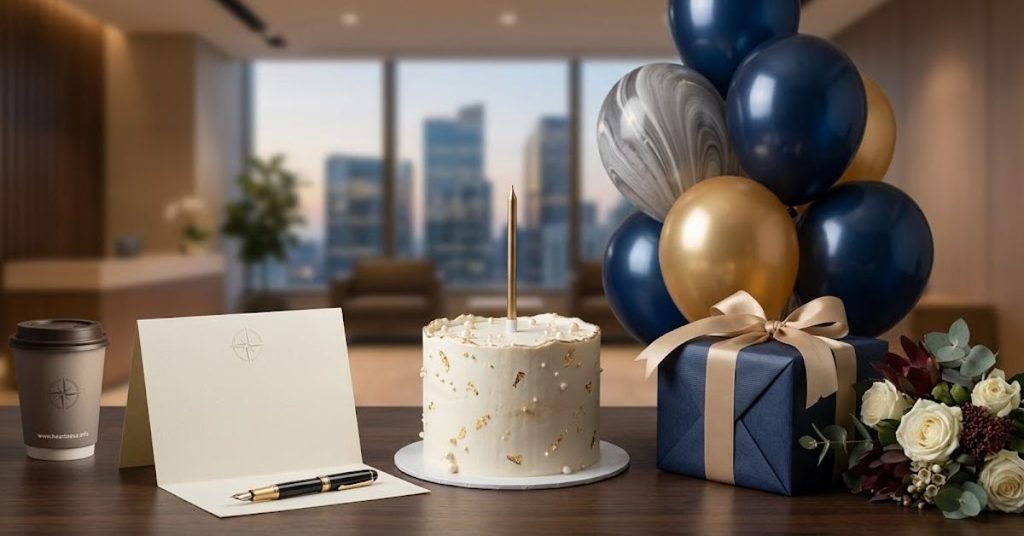
Some client relationships don’t fit the usual pattern. The message that works for a long-term account can feel wrong for a former client, and a warm tone can backfire after a rough project. Each situation below has its own rule, followed by messages you can adapt.
Clients Who Referred You
A referral is a favor, so the birthday message should feel like thanks rather than a payback. Don’t mention how many referrals they’ve sent or what those referrals were worth. That turns a kind gesture into a tally.
1. “Happy birthday, [First name]. Thank you for the introduction to [Person or company]. It meant a lot that you thought of us, and I hope your day is a good one.”
2. “Happy birthday! Being recommended by someone whose opinion we respect is the best compliment we get. I hope today is a great one.”
3. “Dear [Title Surname], on your birthday, I wanted to thank you again for your kind words about our work. Warmest wishes for the year ahead.”
Retired or Former Clients
Reaching out to someone who no longer buys from you shows the message has no agenda. Keep it light, and don’t hint at winning them back. Anything that reads as a re-engagement pitch will undo the goodwill.
1. “Happy birthday, [First name]. I was thinking about our work on [project] and wanted to send my best wishes. I hope you’re doing well.”
2. “Happy birthday! It’s been a while, but I still remember how good it was working with you. I hope this year is a great one.”
3. “Wishing you a very happy birthday, [First name], and a wonderful year in [retirement, your new venture, or the new chapter]. You’ll always be welcome to get in touch.”
Clients You Only Know Remotely
If you’ve never met in person, resist the urge to sound more familiar than you are. Reference something you do share: the calls, the shared documents, the time zone jokes.
1. “Happy birthday, [First name]! Although we’ve only ever met on video, I feel like I know you well after [X months] of calls. I hope your day is a good one wherever you are.”
2. “Happy birthday from [Your city]. I hope the day brings you a good meal and a very short to-do list.”
After a Difficult Project
If a project went badly and the relationship survived, a birthday message can quietly show that the relationship matters more than the problem. Don’t mention the difficulty directly, and don’t overcompensate with extravagant warmth. Simple and sincere works best.
1. “Happy birthday, [First name]. I’ve valued working through the last few months with you, and I hope this year is a smoother one.”
2. “Happy birthday. Thank you for the way you handled a tricky stretch. I hope today is uncomplicated.”
Public-Sector and Regulated Contacts
Many government bodies and regulated organizations restrict gifts and hospitality, and some restrict routine friendly contact as well. A short card or email with no gift and no offer is the safest choice. When in doubt, check the client’s policy or ask a contact in procurement or compliance. The privacy and gift-policy section later in this article covers this in more detail.
1. “Dear [Title Surname], please accept my best wishes on your birthday. It is a pleasure to work with you and your team.”
2. “Dear [Title Surname], with best wishes on your birthday. — [Your name], [Organization]”
These situations depend on context, and so does the next group: industries. A message that suits a law firm may feel out of place at a salon, so the following section adapts the wording to each field.
Professional Birthday Wishes for Clients by Industry
The same message doesn’t work everywhere. A law firm’s client expects restraint, while a salon’s client expects warmth. Each industry below has one rule of thumb, followed by five messages that fit its conventions.
Law Firms and Accounting Practices
Clients of law firms and accountants often share sensitive matters with you, so keep birthday messages formal and free of any reference to their case, tax situation, or finances. A short, courteous note is enough.
1. “Dear [Title Surname], please accept our best wishes on your birthday. It is a privilege to act for you.”
2. “Happy birthday, [First name]. Everyone at [Firm] wishes you a pleasant day and a good year ahead.”
3. “Dear [Title Surname], on your birthday, we send our sincere thanks for the confidence you place in our firm.”
4. “Wishing you a very happy birthday, [First name]. We hope the day gives you time to relax and enjoy yourself.”
5. “Dear [Title Surname], it has been a pleasure working with you this year. Best wishes for a happy birthday. — [Your name], [Partner or Director]”
Financial Advisors and Wealth Managers
Never tie a birthday message to returns, markets, or “growing wealth.” It can sound like a pitch, and in a regulated field it may also draw scrutiny. Focus on the personal relationship and long-term trust.
1. “Happy birthday, [First name]. Thank you for the trust you’ve placed in me. I hope today is a good one, whatever the markets are doing.”
2. “Dear [Title Surname], warmest wishes on your birthday. It is a real pleasure to work with you and your family.”
3. “Happy birthday, [First name]. I hope you spend the day on something you enjoy. Work can wait.”
4. “Wishing you a happy birthday and a year of good health and good company. — [Your name]”
5. “Happy birthday from all of us at [Firm]. Your confidence in our team means a great deal.”
Real Estate, Mortgage, and Insurance Professionals
Your clients often stay in touch for years, sometimes with long gaps. A birthday message keeps you in their mind without a sales push. Referencing the home, if it’s a positive memory, adds warmth.
1. “Happy birthday, [First name]! I hope you’re enjoying the new place and that today is a great one.”
2. “Wishing you a very happy birthday. It was a pleasure helping you find your home, and I hope this year is a wonderful one.”
3. “Happy birthday, [First name]. Thank you for trusting me with such a big decision. I hope the day is a good one.”
4. “Dear [Title Surname], best wishes on your birthday from everyone at [Agency]. We’re always here if you need anything.”
5. “Happy birthday! I hope you’re having a great day, with plenty of cake and no paperwork.”
Agencies, Consultants, and Freelancers
Creative and advisory clients usually enjoy a little personality. Use the friendlier end of the tone dial, and if you’re a solo freelancer, sign with your own name. Solo senders can also be more informal, because the relationship is more personal.
1. “Happy birthday, [First name]! I hope you get a day free of feedback rounds, revision requests, and deadlines.”
2. “Happy birthday! Working on [project] with you has been a highlight of my year. I hope today is a great one.”
3. “Wishing you a happy birthday, [First name]. Thank you for the clear briefs and the honest feedback. Both make the work better.”
4. “Happy birthday from the whole [Agency] team. We’re glad to be on your side.”
5. “Happy birthday, [First name]. I hope today’s schedule is empty, and tomorrow’s is exciting.”
IT, SaaS, and B2B Service Providers
Your client contacts are often busy and juggling many vendors. Short, low-effort messages work best. Avoid tech jargon and never mention outages, tickets, or usage numbers.
1. “Happy birthday, [First name]! I hope today brings no alerts, no tickets, and lots of cake.”
2. “Happy birthday from the [Company] team. We’re glad to support you and your team, and we hope today is a good one.”
3. “Wishing you a happy birthday, [First name]. Thanks for being a great partner this year.”
4. “Happy birthday! I hope today goes exactly as planned, which is rare in our line of work.”
5. “Dear [Title Surname], please accept our best wishes on your birthday. We appreciate your team’s partnership.”
Healthcare, Dental, and Wellness Practices
Patient privacy comes first. Do not mention treatment, appointments, conditions, or health goals in a birthday message, and avoid putting anything sensitive in a subject line or a text preview. A greeting with a first name and the practice name is enough. Rules on health information vary by country and entity, so confirm your process with whoever handles compliance.
1. “Happy birthday, [First name]! Everyone at [Practice] wishes you a wonderful day.”
2. “Warm birthday wishes from your team at [Practice]. We hope the day is a happy one.”
3. “Happy birthday, [First name]. Thank you for being part of our community. Enjoy your day.”
4. “Wishing you a very happy birthday from all of us at [Practice].”
5. “Happy birthday! We hope today brings you time to enjoy the things you love.”
Salons, Spas, and Personal Services
Clients of personal-service businesses often see the same person every few weeks, so the relationship is closer. A warm, friendly message works well. Avoid remarks about appearance, age, or how they “should” look.
1. “Happy birthday, [First name]! I hope your day is full of good company and good food.”
2. “Wishing you a lovely birthday from all of us at [Salon]. It’s always a pleasure to see you.”
3. “Happy birthday! Treat yourself today. You’ve earned it.”
4. “Happy birthday, [First name]. Thank you for being one of our favorite people to see. Enjoy your day.”
5. “From the whole [Salon] team: happy birthday, and here’s to a great year ahead.”
Contractors and Home Services
Your clients have let you into their homes, and trust is central. A straightforward, friendly message is best, and referencing the work you did is natural and welcome, as long as it’s positive.
1. “Happy birthday, [First name]! I hope you’re enjoying the [kitchen, deck, or bathroom] and that today is a great one.”
2. “Wishing you a very happy birthday from all of us at [Company]. Thank you for letting us work on your home.”
3. “Happy birthday, [First name]. It was a pleasure working with you, and I hope this year is a good one.”
4. “Happy birthday! I hope your day is free of leaks, cracks, and anything that needs repairing.”
5. “Best wishes on your birthday, [First name]. Thank you for trusting us with your home. — [Your name], [Company]”
Industry wording suits the message itself, but the channel matters too. The next section covers short texts and chat messages, where brevity and permission count for even more.
Short Birthday Texts and Chat Messages for Clients

A text or chat message lands in a personal space, so the bar is higher than for email. Send one only if the client already uses that channel with you. If they’ve never texted you back, use email or a card instead. The privacy section later in this article covers consent rules for automated and promotional messages.
Keep these to one or two lines, and make sure the client knows who is writing. If your number isn’t saved in their phone, include your name and company.
SMS Messages
1. “Happy birthday, [First name]! Hope you have a great day. — [Your name], [Company]”
2. “Wishing you a happy birthday, [First name]. Enjoy the day! — [Your name]”
3. “Happy birthday, [First name]. Thanks for a great year working together. — [Your name], [Company]”
4. “Happy birthday! Hope today is a slow and pleasant one. — [Your name]”
5. “Happy birthday from all of us at [Company], [First name]. Enjoy your day!”
6. “Quick note to say happy birthday, [First name]. No reply needed, just a good wish. — [Your name]”
WhatsApp and Business Chat Messages
WhatsApp, Teams, Slack Connect, and similar tools tend to be more casual, and clients often use them with people they work with daily. That makes a friendlier tone acceptable, and an emoji is fine if the client uses them too. Match their style, and never add a business pitch to a chat greeting.
1. “Happy birthday, [First name]! Hope you get a proper break today 🎂”
2. “Happy birthday! Thanks for being such a great person to work with. Enjoy your day.”
3. “Happy birthday, [First name]! Nothing work-related today. Just a wish for a good one.”
4. “Many happy returns, [First name]! Have a lovely day.” (A natural fit for UK and Commonwealth clients.)
5. “Happy birthday from the whole team, [First name]! We hope it’s a great one.”
6. “Happy birthday! Go enjoy the day. Everything else can wait until tomorrow.”
LinkedIn Messages
LinkedIn often prompts you to congratulate connections on their birthdays. That prompt makes a message expected but also easy to ignore, so a personal line works better than the pre-filled default. Send it as a direct message, not a public post, unless you know the client is comfortable with public greetings.
1. “Happy birthday, [First name]! I hope you have a great day.”
2. “Happy birthday, [First name]. It’s been a pleasure working with you this year. Enjoy your day.”
3. “Wishing you a very happy birthday, [First name]. Best wishes for the year ahead.”
4. “Happy birthday! I hope it’s a good one, and that the year brings some well-deserved wins.”
5. “Happy birthday, [First name]. Thanks for being a great connection and a great client.”
6. “Many happy returns, [First name]. Hope you have time today to celebrate.”
Birthday Email Subject Lines and Card Openers
A subject line decides whether the email gets opened, and a plain one signals that it’s a personal note, not a promotion. Leave out emojis, exclamation marks in capitals, and words like “special offer” or “gift for you.” Keep any client detail out of the subject line, because previews can show up on lock screens and shared inboxes.
Subject Lines
1. Happy birthday, [First name]
2. A birthday note from [Company]
3. Best wishes on your birthday
4. Thinking of you on your birthday
5. Birthday wishes from all of us
6. Wishing you a happy birthday
7. A quick birthday hello
8. Happy birthday from [Your name]
9. Celebrating you today
10. With warm wishes on your birthday
11. Just a birthday note
12. Happy birthday, from your team at [Company]
Card Openers
These are the first lines of a card or email body, and each pairs with a nod and a wish from the formula above.
1. “Dear [First name], I hope today is a good one.”
2. “Dear [Title Surname], please accept my warm wishes on your birthday.”
3. “Hello [First name], a quick note to say happy birthday.”
4. “Dear [First name], today is a good day to celebrate you.”
5. “Dear [First name], we wanted to take a moment on your birthday to say thank you.”
Everything so far has been straightforward and sincere. Some clients would enjoy a lighter touch, but humor is easy to get wrong in a professional relationship, so the next section covers how to do it safely.
Light-Hearted Birthday Messages for Clients
Humor can make a client smile, but it carries more risk than any other tone. A joke that works between friends can land badly in a professional relationship, especially in writing, where there’s no tone of voice to soften it.
Use a simple test before sending: would this still be fine if the client forwarded it to their boss? If not, cut it.
Safe territory: meetings, inboxes, coffee, cake, deadlines, and the small annoyances of work. These jokes are about a shared experience, not about the person.
Off limits: age, appearance, health, relationship status, money, and anything suggesting the client owes you loyalty. Skip jokes like “we hope you never switch providers,” which can sound needy or possessive.
Match the humor to what you already know. If your client has never joked with you, stay with a sincere message.
1. “Happy birthday, [First name]! May your inbox be empty and your cake be large.”
2. “Happy birthday! I hope today involves zero status meetings and at least one dessert.”
3. “Wishing you a birthday with no urgent emails, no last-minute changes, and plenty of good coffee.”
4. “Happy birthday, [First name]! I promise not to schedule anything today. Enjoy the day off from us.”
5. “Happy birthday! Today, the only deadline is dinner.”
6. “Happy birthday, [First name]. I hope your calendar has fewer meetings than candles on the cake.” (Only use this if the client has joked about their calendar. It hints at age otherwise.)
7. “Happy birthday! I’ve checked, and today is officially a no-spreadsheets day.”
8. “Wishing you a happy birthday, [First name], and a phone that stays quiet until tomorrow.”
9. “Happy birthday from all of us at [Company]. We’ve agreed to be very quiet today, so you can enjoy it.”
10. “Happy birthday, [First name]! Here’s to a day with no revision requests.” (Suits agencies and freelancers whose clients enjoy banter about feedback.)
11. “Happy birthday! I hope your day is as smooth as a project with a perfect brief.”
12. “Happy birthday, [First name]. Today, we’re pausing all deliverables in your honor.”
Milestone Birthdays: When to Mention the Number
Round-number birthdays such as 30, 40, 50, and 60 feel like an occasion, which tempts people to mention the age. In a client relationship, it’s usually best to acknowledge the milestone without naming the number.
The reason is simple. Some people love the attention, while others find it uncomfortable. You often can’t tell which, and you can’t take a message back once it’s sent. If the client has celebrated openly, for instance by sharing party photos or announcing the number themselves, you can follow their lead. Otherwise, refer to “a milestone birthday” or “a big year,” or leave the milestone out altogether.
A good compromise for close, long-term clients is to mention the occasion but not the age, and to keep the wish focused on the year ahead.
1. Discreet milestone nod:“Happy birthday, [First name]! I hope this milestone year is a wonderful one.”
2. Focus on the year ahead:“Happy birthday. Here’s to a great new chapter and everything it holds.”
3. For a client who has shared the news:“Happy [number]th birthday, [First name]! Congratulations, and I hope the celebrations are as good as you deserve.”
4. Formal version:“Dear [Title Surname], please accept my warmest wishes on your birthday. I hope this special year brings you every happiness.”
5. Warm and appreciative:“Happy birthday, [First name]. It’s a pleasure to celebrate a big one with someone we’ve enjoyed working with for so long.”
6. Understated:“Happy birthday, [First name]! Wishing you a memorable day and a wonderful year.”
7. For a senior client, from a senior sender:“Dear [First name], on this important birthday, I want to thank you for your friendship and your partnership. I hope the year ahead is a great one. — [Your name]”
8. Team-signed card line:“Wishing you a very happy birthday and a fantastic celebration from all of us at [Company].”
The next few sections deal with timing and slips: what to do when you’re late, and how to include a small gift or offer without spoiling the sentiment.
Belated Birthday Messages for Clients

Missing a birthday happens, and the fix is easy: send the message as soon as you notice, and keep the apology to a few words. A long explanation draws more attention to the slip than the slip itself deserved.
Don’t wait for a “better” moment. A message a few days late still feels thoughtful. After two or three weeks, it’s fine to send if you’re sincere about it, but consider adding a small nod so it doesn’t feel like a chore you were catching up on. If you found out the date only after it had passed, you can skip the apology altogether and simply send your wishes.
1. One line, no fuss:“Happy belated birthday, [First name]! I hope you had a wonderful day.”
2. Brief apology:“Apologies for the delay, [First name]. Happy belated birthday, and I hope the day was a good one.”
3. Formal version:“Dear [Title Surname], please accept my belated best wishes on your birthday. I hope it was a pleasant one.”
4. Warm and honest:“Happy belated birthday, [First name]! I’m sorry I missed the day itself, but I hope it was a great one.”
5. With a nod:“Happy belated birthday! I hope you had time to celebrate after the [project or busy period]. You’ve earned it.”
6. Slightly lighter:“Happy belated birthday, [First name]! Better late than never. I hope you had cake.”
7. When you learned the date late:“Happy birthday for last week, [First name]! I only just found out and didn’t want to let it pass. I hope it was a good one.”
8. After a week or more:“Happy belated birthday, [First name]. I hope the celebration was everything you wanted, and that the year ahead brings good things.”
9. For a long-term client:“I’m sorry I’m late, [First name], but happy birthday! After all these years, I’d hate to have missed it entirely.”
10. From a team:“Happy belated birthday from all of us at [Company]. We’re sorry we’re a little behind, but we hope you had a lovely day.”
Birthday Messages With a Small Gift or Offer
A gift or an offer can be a pleasant gesture, but it changes how the message is received. A sincere greeting on its own reads as warmth. The same greeting with a discount attached can read as marketing, even when the intent was kind.
A few principles help:
• Send the greeting first. If you plan to include an offer, send it as a separate message a few days after the birthday wish. That way the wish stands on its own.
• Say what it is. State the benefit, any conditions, and the expiry date plainly. Don’t call something a “gift” if the client has to spend money to receive it.
• Skip it for new and formal relationships. A gift can feel presumptuous early on.
• Check the client’s rules. Many organizations, particularly in the public sector and regulated industries, limit the gifts their staff can accept. The privacy and gift-policy section covers this.
• Keep it modest. A small, thoughtful token usually lands better than something expensive, which can make a client uncomfortable.
1. Greeting only (the default):“Happy birthday, [First name]. Nothing to sell today, just a sincere wish for a good one.”
2. A small card and note:“Happy birthday, [First name]! A little card is on its way. I hope it brightens your day.”
3. A small gift, no strings:“Happy birthday from all of us at [Company]. We’ve sent a small treat to your office. Please share it with your team.”
4. A follow-up offer, sent separately:“Hi [First name], to mark your birthday month, we’d like to offer you [clear benefit]. It’s valid until [date]. [Any conditions.]”
5. A donation in their name:“Happy birthday, [First name]. In your honor, we’ve made a donation to [charity]. We hope you like the thought.”
6. A complimentary add-on:“To mark your birthday, we’d like to include [approved extra] with your next [service or order] before [date]. Happy birthday!”
7. For a long-term client:“Happy birthday, [First name]. As a thank-you for [X years] together, we’d like to give you [benefit]. No action needed. It’s just our way of saying thanks.”
8. When gifts aren’t allowed:“Happy birthday, [First name]. We know gifts aren’t possible in your role, so please accept our sincere best wishes instead.”
Once you’ve got the words, the questions that follow are practical ones: when to send, through which channel, and what to avoid. The next sections cover timing and channel.
When to Send a Client Birthday Message
The best time is the day itself, or for physical cards, just before it. A greeting that arrives on the day feels attentive, while one that arrives a week late feels like an afterthought. The right moment still depends on the channel and the client.
Email and text: send in the morning, in the client’s time zone, not yours. A message that lands at 6 a.m. their time, or in the middle of their night, feels careless. If you work across time zones, schedule the send instead of sending it when you happen to remember.
Cards: mail them a few days ahead so they arrive on or just before the birthday. A card that arrives after the date is a belated card, however good the wording. Allow extra days for international post and for offices where mail goes through a central desk.
Weekend and holiday birthdays: for personal channels like a text or LinkedIn message, send on the day itself, since the client may enjoy it more at home. For email to a work address, a weekend message can sit unread until Monday. In that case, send it on the Friday before or the Monday after, and make it clear which one it is (“Happy belated birthday” on Monday, or “Happy early birthday” on Friday).
Early wishes: in some places, greeting someone before the date is considered unlucky. The regional etiquette section covers this. If you’re unsure about a client’s culture, send on the day.
Send one message, not a sequence. A single greeting is a gesture. Three touches across email, text, and LinkedIn on the same day is pressure. If your CRM triggers multiple channels automatically, turn the extras off.
Avoid the same date for a business event. Don’t pair a birthday message with a renewal notice, an invoice, or a survey request. Even if they’re unrelated, the timing makes the greeting look like a lead-in.
Email, Card, Text, LinkedIn, or Call: Choosing the Channel
The channel says as much as the words. A handwritten card says “I took time.” A text says “I’m comfortable contacting you directly.” Choose the one that fits how the client already communicates with you, not the one that’s easiest for you.
| Channel | Best for | Watch out for | Suggested tone level |
| Handwritten card | Key accounts, long-term clients, senior contacts | Arrival timing, client mail handling, gift policies | 1–3 |
| Personal email | Almost any client | Being ignored in a crowded inbox, subject line wording | 1–3 |
| Bulk or automated email | Large client lists (tier 3 in the system below) | Broken merge tags, opt-out rules, sounding like a promotion | 2 |
| SMS | Clients who already text you | Consent rules, spam filters, saved-number confusion | 2–3 |
| WhatsApp or business chat | Clients who already chat with you there | Over-familiarity, mixing greetings with work updates | 3–4 |
| LinkedIn message | Clients you mainly know through LinkedIn | Generic pre-filled greetings | 2–3 |
| Phone call | Close, long-term clients | Catching them at a bad time, no record if they miss it | 3–4 |
A simple rule: use the channel the client already uses with you. If they reply to your emails within an hour but never answer texts, send an email. If you chat on WhatsApp daily, a formal letter would feel odd.
Combining channels: for your most important clients, a card plus a brief personal email works well, but send them on the same day or a day apart, not both at once.
Phone calls carry the most personal weight but are also the easiest to get wrong. Call only when the relationship is close, and expect voicemail. A short voicemail such as “Hi [First name], it’s [Your name]. Just calling to wish you a happy birthday. No need to call back” works well, and a follow-up text saying the same thing means they still have it in writing.
Once you know when and how to send, it’s worth knowing what to leave out, since a single misjudged line can undo the whole gesture. That’s covered in the next section.
What to Avoid in a Client Birthday Message
Most birthday messages that go wrong fail for one of a few reasons. Each mistake below is followed by what to do instead.
Mentioning age.“Another year older” and “over the hill” jokes are risky with clients. Even a kind “you don’t look 50” implies you’ve been assessing them. Celebrate the day, not the number, unless they’ve announced it themselves.
Commenting on health, appearance, or family. Wishes such as “good health for you and your family” seem harmless, but they assume things you may not know. A client who is unwell, estranged, or grieving can read them very differently. Keep the wish about them and their year.
Possessive humor. Lines like “we hope you never leave us” or “may you always need our services” turn a greeting into a retention tactic. Clients notice, and it can sound insecure.
Wealth and prosperity hyperbole.“May riches flow to you all your days” sounds like an old-fashioned card and can feel out of place in a professional relationship. Something plain like “a year of good decisions” fits better.
Religious or cultural assumptions. Blessings and prayers suit some clients and alienate others. Not everyone celebrates birthdays, and some decline for religious or personal reasons. If a client has never mentioned faith, keep the wording secular. If they don’t respond warmly to a birthday message, don’t push. Stop sending.
The unsubstituted merge tag.“Happy birthday, [First name]” landing in a client’s inbox is worse than sending nothing. Test the exact message, including what happens when a name field is empty, before any automated send.
The wrong person’s name or the wrong date. Confirm both. A greeting on the wrong day reads as careless, and a wrong name can hurt the relationship.
A hidden ask.“Happy birthday! By the way, could you review us?” ruins the greeting. The same goes for a renewal reminder or invoice in the same email.
An over-long message. If it takes more than a few seconds to read, the point is lost. Three sentences is plenty.
The reply-all or public post. Sending a greeting to a group thread, or posting on a client’s LinkedIn wall, exposes their birthday to people who may not know it. Use a direct message unless the client already shares it publicly.
Nothing at all, forever. Skipping birthdays is better than sending a poor message, but a client who receives a greeting one year and none the next may notice. Whatever level of contact you choose, keep it consistent.
Tone and Etiquette by Region: US, UK, and Europe
Birthday wishes travel across borders, but the small conventions don’t. The same message can feel warm in one country and too familiar in another. If your clients are spread across regions, adjust these details rather than sending one version everywhere.
United States
American business communication tends toward first names and a friendly, direct tone, even with new clients. Exclamation marks are normal, and a short “Happy birthday, [First name]!” is rarely too casual. Common sign-offs include “Best,””Best regards,” and “Warm regards.” Use US spelling (for example, “honor” and “celebrate”), and write dates as month/day/year.
United Kingdom
British clients often prefer a little more reserve, particularly at first. Use “Dear [Name]” in emails to new or senior contacts, and move to first names only once they do. “Many happy returns” is a familiar, well-liked phrase. Sign-offs such as “Kind regards” and “Best wishes” are standard. Use UK spelling (for example, “honour” and “organisation”) and write dates as day/month/year. Understatement goes down well, and effusive praise can feel awkward.
Continental Europe
Practices vary widely, so treat clients as individuals and check their preferences.
• Formality: in Germany, France, and many other countries, formal address is still the default in business until the client invites otherwise. Use a title and surname until they say otherwise.
• Early wishes: in Germany, wishing someone a happy birthday before the day itself is widely seen as bad luck, even if the greeting is only minutes early. For German clients, send on the day, not before, and pass on the “early birthday” idea for cards. If a card must be posted, time it to arrive on the day.
• Name days: in several European countries, including Greece, Poland, and Hungary, name days are also celebrated. If you know a client keeps one, acknowledging it can be a thoughtful extra, but it’s not a substitute for a birthday message.
• Round birthdays: decade birthdays are often marked more elaborately in parts of Europe. That doesn’t mean you should mention the age. Follow the milestone guidance earlier in this article.
• Language: if your client isn’t a native English speaker, keep the wording simple and avoid idioms. A short greeting in their own language, such as “Alles Gute zum Geburtstag” or “Joyeux anniversaire,” shows effort. Check the wording with a native speaker before sending.
Across all regions
• Send in the client’s time zone, and check local public holidays.
• If you don’t know their preferences, choose the more formal option and let them set the pace.
• Never assume every client celebrates. If a client has said they don’t, respect that fully and without comment.
The etiquette above covers how a message feels. The next two sections cover the practical side: what the law and workplace rules say about contacting clients, and how to manage all of this without a spreadsheet nightmare.
Privacy, Consent, and Gift-Policy Basics
A birthday greeting feels harmless, but it involves a piece of personal data and a channel of contact. A few basics keep it that way. This is general information, not legal advice. If you send at scale or work in a regulated field, have someone qualified review your process.
Is a birthday message “marketing”?
That depends on what’s in it. In the US, the CAN-SPAM Act covers messages whose primary purpose is the commercial advertisement or promotion of a product or service, and the law makes no exception for business-to-business email. A plain greeting with no promotion is unlikely to meet that test. Once you add an offer, a product mention, or a call to action, you’re closer to commercial territory.
If a message is commercial, the FTC’s guide lists requirements such as accurate header information, a subject line that reflects the content, and a valid physical postal address. Under the same law, recipients have the right to have you stop emailing them, so build an opt-out into any commercial message and honor it.
The same logic is one more reason to keep the greeting and any offer separate, as suggested earlier. The greeting stays a greeting, and the offer can carry its own terms and opt-out.
Text messages
In the US, separate rules under the Telephone Consumer Protection Act, enforced by the FCC, govern consent for automated and marketing texts and calls. A one-to-one text you type yourself to a client who already texts you is very different from an automated campaign that texts an entire list. If you automate, confirm that you have consent for that channel and that opt-outs actually suppress future sends.
UK and Europe
In the UK, the Privacy and Electronic Communications Regulations (PECR) apply to electronic direct marketing. According to the ICO’s guidance, you can send unsolicited electronic mail marketing to individual subscribers only with consent or under the soft opt-in, while such marketing to corporate subscribers doesn’t need either. The distinction matters: individual subscribers include sole traders and some types of partnership, so a freelancer client is treated differently from a limited company. Either way, you must not hide your identity and must give a valid contact address for opting out.
PECR works alongside the UK GDPR and the Data Protection Act 2018, and EU countries have their own versions of these rules. A birth date is personal data under GDPR-style laws, so how you collect, store, and use it matters even when the message itself is not marketing.
Handling the birth date itself
• Collect the minimum. Day and month are enough for a greeting. Don’t store the birth year unless you have a separate, genuine need.
• Record where it came from and whether the client knows you’ll use it. A date the client gave you for this purpose is on firmer ground than one copied from a social profile.
• Limit who can see it. Keep it out of shared spreadsheets and broad email groups.
• Honor requests to stop, and record them somewhere the sender will actually see.
Sensitive sectors
If you work in healthcare, legal, or financial services, keep treatment details, case details, and account details out of birthday messages, subject lines, and text previews. A first name and the organization’s name are usually enough.
Client gift and hospitality policies
Many organizations, especially public bodies, regulated companies, and large corporations, restrict the gifts their staff may accept, and some restrict the value or even the acceptance of any gift. Anti-bribery rules in some jurisdictions add to the caution. Even a modest gift can put a client in an awkward position, or put your own company at risk.
Before sending anything beyond a card or message:
1. Check whether your client’s organization has a published policy, or ask a neutral contact such as procurement or an executive assistant.
2. Check your own company’s rules on client gifts.
3. When in doubt, send a message instead of a gift. The gift-and-offer section earlier includes a version written for exactly this situation.
A Three-Tier System for Managing Client Birthdays
Once you have more than a handful of clients, memory stops working, and inconsistency creeps in. One client gets a handwritten card, another gets nothing, and a third gets a broken merge tag. A simple tiering system fixes this by matching effort to the relationship.
The Three Tiers
| Tier 1: Personal | Tier 2: Personalized | Tier 3: Light-touch | |
| Who | Key accounts, long-term clients, senior contacts | Regular clients you work with actively | Occasional, transactional, or large-volume clients |
| Format | Handwritten card, plus a short personal email or call | Individual email or text with one specific nod | Short, warm email with the client’s name; sent on a schedule |
| Sender | The account owner or a senior leader | The person who works with the client | The company or team |
| Tone level | 2–4 | 2–3 | 2 |
| Prep time | A few minutes per client | About a minute per client | Set up once, then review |
| Check before sending | Gift policy, card arrival date | Name spelling, accuracy of the nod | Merge tags, opt-outs, missing-name fallback |
Assign tiers by the value of the relationship to both sides and by how well you know the client, not only by revenue. A small client who’s been with you for a decade and a friend of your business may deserve Tier 1.
What to Track
A simple spreadsheet or CRM record is enough. Useful fields:
• Name and how they prefer to be addressed
• Title and organization
• Birth day and month (no year)
• Where the date came from, and whether they know you’ll use it
• Preferred channel
• Tier
• Regional or cultural notes (formal address, day-of-only greetings, no birthday celebrations)
• Gift policy notes
• Last nod used, so you don’t repeat the same detail each year
• Date and channel of the last message sent
• Opt-out status
A Simple Monthly Rhythm
1. First week of the month: list the birthdays for the coming month by tier.
2. Ten days before: post Tier 1 cards, allowing extra time for international mail.
3. Two or three days before: draft or schedule Tier 2 messages with a fresh nod.
4. The day itself: send in the client’s time zone. Check that Tier 3 scheduled sends are set correctly.
5. End of the month: note any bounces, replies, or opt-outs, and update your records.
A system like this doesn’t make the message any less sincere. It simply makes sure that the sincerity happens on time, every time.
Other Client Messages Worth Sending Through the Year
A birthday is one of several moments when a short, no-agenda message is welcome. Clients who hear from you only once a year, on a date every vendor knows, may feel the gesture is routine. Spreading your contact across a few different moments makes each one feel more genuine, and none of them needs to be long.
Work anniversary with your company. Marking the anniversary of your first project is a natural way to recognize a long relationship without the personal territory of a birthday. Sample:“It’s [X years] since we started working together, [First name]. Thank you for the trust, and here’s to the next chapter.”
A thank-you after a completed project. Sent within a few days of finishing, it lands while the work is still fresh. Sample:“Thank you for a great collaboration on [project], [First name]. It was a pleasure, and I hope the result is everything you wanted.”
Congratulations on their win. A promotion, an award, a funding round, or a product launch that the client has shared publicly is worth a line. It shows you follow their progress, not just their invoices. Sample:“Congratulations on [achievement], [First name]. It’s a great result, and well deserved.”
Seasonal and holiday greetings. Keep them inclusive: “Season’s greetings” or “Wishing you a restful break” avoids assuming which holiday a client observes, and works across regions. Sample:“Wishing you a restful end to the year, [First name]. Thank you for everything we’ve done together.”
A new-year note. The start of a year is a good time for a short forward-looking message that expresses appreciation and interest in the year ahead, without a pitch. Sample:“Happy new year, [First name]. I’m looking forward to working with you again in the months ahead.”
A “no reason” check-in. A brief note during a quiet stretch, with no ask, tells a client that you’re thinking about the relationship between projects. Sample:“No agenda, [First name]. I just wanted to say I enjoyed working with you on [project], and I hope things are going well.”
Sensitive moments. If a client shares news of a bereavement, illness, or a similarly hard time, a short, sincere note is appropriate and often deeply appreciated. Keep it simple, don’t ask for details, and don’t attach any business mention.
Colleagues and internal teams. If your own team’s contact with a client is handled by several people, coordinate. A client who receives a birthday message from three colleagues in different formats may feel overwhelmed. If you’re writing to your own coworkers, boss, or team members, those are separate occasions with their own conventions.
FAQ’s
What do you write in a birthday message to a client?
Keep it to one to three sentences: address them by name, add one true detail about your work together, and end with a wish for their day or year. For example: “Happy birthday, Priya. Getting your rebrand launched on time was the highlight of our year, and I hope this one brings you a well-earned pause.” Leave out anything that asks for something.
Is it appropriate to send a birthday message to a client?
Yes, in most client relationships, provided the message is short, sincere, and free of a sales pitch. Match the warmth to the relationship, and use a formal tone for new clients and senior contacts. If a client has said they don’t celebrate birthdays, respect that and don’t send one.
Should I mention my client’s age in a birthday message?
Usually not. Some people enjoy the attention and others find it uncomfortable, and you can’t easily tell which. Celebrate the day instead. The exception is a client who has openly announced a milestone themselves, in which case following their lead is fine.
Is it okay to text a client happy birthday?
It is if the client already texts with you. A one-to-one text you write yourself is very different from an automated campaign, which needs consent and a working opt-out. If the client has never replied to a text, use email or a card instead.
Should I include a discount or offer in a client birthday message?
It’s better to keep the greeting and any offer separate. A birthday wish that ends in a promotion can read as insincere, even when the intent is kind. If you want to give an offer, send it a few days later, state the terms plainly, and skip it for new clients and for those whose organizations restrict gifts.
When is the best time to send a birthday message to a client?
Send it on the birthday itself, in the client’s time zone, ideally in the morning. Cards should be posted a few days ahead so they arrive on or just before the date. For clients in Germany, send on the day, not before, since early wishes are widely seen as bad luck there.
What should I do if I forgot a client’s birthday?
Send a short message as soon as you notice, with a brief apology or none at all. “Happy belated birthday, [First name]! I hope you had a wonderful day” is enough. A long explanation draws more attention to the slip than the slip itself deserved.
How do I find out my clients’ birthdays without being intrusive?
The best way is to ask directly, for example as an optional field during onboarding, and explain that you’d like to send a greeting. Day and month are enough, and you don’t need the year. Avoid piecing dates together from social profiles or other sources, and record where each date came from.
Can I send a funny birthday message to a client?
You can, if you already share humor with them and keep the joke about a common experience such as meetings, inboxes, or cake, not about the person. Avoid jokes about age, appearance, money, or the client’s loyalty. If you’re unsure, a sincere message is the safer choice.
Conclusion
The best professional birthday wishes for clients are short, sincere, and specific. A name, one true detail about your work together, and a wish with nothing attached will do more for a relationship than a page of polished phrases.
Match the warmth to the relationship, send on the day in the client’s time zone, and choose the channel they already use with you. Keep age, health, and possessive jokes out of it, and keep any offer separate from the greeting. If you have many clients, a simple tiered routine means each one hears from you on time, with wording that fits.
Pick a message from the sections above, change one line so it sounds like you, and send it.

Creating heartfelt wishes, greetings, and inspiring messages to help you celebrate special moments, spread positivity, and express your feelings beautifully.
2 thoughts on “Professional Birthday Wishes for Clients: 180+ Messages for Every Relationship, Industry, and Channel”