

Some people drift into your thoughts for no reason at all, and the urge to say something is hard to ignore. Maybe it’s an old friend, a cousin in another time zone, or a former coworker you still think of fondly.
The best thinking of you hope all is well messages are short, sincere, and don’t demand much in return. They say “you matter to me” without adding pressure to reply or explain a long silence.
Below are 105 messages written for different relationships, moods, and amounts of time apart. Each one is tagged by how much reply it asks for, so you can match the message to the moment.
Key Takeaways
- A good check-in is one or two sentences. Longer messages often feel like they need a long answer.
- One specific detail (a place, a joke, a shared memory) makes a message feel personal, even when the rest is simple.
- Every message here is tagged [No reply needed], [Open door], or [Invitation] so you control how much response you’re asking for.
- “We should catch up soon” without a plan usually goes nowhere. If you want to talk, suggest something concrete.
The Best Thinking of You, Hope All Is Well Messages to Send Right Now
If you only need one message in the next minute, start here. These ten work for almost anyone, and each takes a different approach, so you can pick the one closest to how you actually feel.
A quick guide to the tags: [No reply needed] means the message can stand alone. [Open door] invites a reply without requiring one. [Invitation] suggests a next step, like a call.
- The simplest version. “Thinking of you today and hoping all is well. No need to reply, I just wanted you to know.” [No reply needed]
- The warm general check-in. “You crossed my mind this morning, and I realized I hadn’t told you lately how glad I am to know you. Hope all is well with you.” [No reply needed]
- The memory anchor. “Walked past the café where we used to drink those terrible coffees and thought of you. Hope all is well. How are things?” [Open door]
- The honest acknowledgment of time. “It’s been a while, and I’ve been meaning to say hi. Thinking of you and hoping life is treating you kindly.” [Open door]
- The simple week wish. “Thinking of you and hoping this week is a good one for you.” [No reply needed]
- The concrete invitation. “Thinking of you and hoping all is well. If you’re up for a call this weekend, I’d love to hear how you’ve been.” [Invitation]
- The no-reason message. “There’s no reason for this text other than that you matter to me. Hope all is well.” [No reply needed]
- The gratitude angle. “I was remembering the time you showed up for me when I really needed it. Hope all is well with you, and thank you again.” [No reply needed]
- The gentle and light one. “Thinking of you and hoping your day has been full of small good things.” [No reply needed]
- The seasonal check-in. “Thinking of you as the season changes. Hope all is well and you’re keeping warm and well.” [No reply needed]
To make any of these your own, swap in one real detail: the café, the song, the nickname. That single change does more than extra adjectives. If you’re writing from the UK or Europe, “keeping well” and “hope you’re well” read naturally in place of “hope all is well.”
Short Thinking of You, Hope All Is Well Text Messages
A short text works because it asks almost nothing of the person reading it. They can read it in one glance, smile, and answer when they have the energy, or not at all.
Here is a quick check before you send. Read the message aloud in a single breath. If you run out of air, trim it. A text under about 20 words rarely feels like a burden, however long it’s been since you last spoke.
These twelve are written for different moments and personalities. Pick by situation, not just by wording.
Quick Hellos
- The five-word text. “Thinking of you. Hope you’re well.” [No reply needed]
- The “just because” hello. “A little hello from someone who’s thinking of you and hoping all is well.” [No reply needed]
- The low-pressure line for busy people. “Hope all is well! Thinking of you, and no pressure to answer. I know weeks get busy.” [No reply needed]
- The understated one. “Not much to say, really. I think about you often and hope all is well.” [No reply needed]
Messages Tied to a Moment
- The Sunday-evening text. “Sunday-evening thought: hoping the week ahead is gentle with you. Thinking of you.” [No reply needed]
- The morning text. “Good morning, and a quick thinking-of-you. Hope your day goes smoothly.” [No reply needed]
- The midday nudge. “Midday reminder that you’re doing better than you think. Thinking of you, hope all is well.” [No reply needed]
- The goodnight text. “Goodnight thought: hope you’re well and resting easy. Thinking of you.” [No reply needed]
Texts That Gently Invite a Reply
- The photo share. (Attach a photo of something that reminded you of them.) “Saw this and thought of you. Hope all is well!” [Open door]
- The song text. “A song just came on that reminded me of you. Hope all is well and you’re doing great.” [Open door]
- The one-question text. “Thinking of you and hoping all is well. What’s one good thing that happened this week?” [Open door]
- The emoji version. “Thinking of you 🌿 Hope all is well.” Pick one emoji that matches the person (a plant for a gardener, a coffee cup for a fellow caffeine fan). Using several can read as generic. [No reply needed]
A small detail about punctuation: a full stop gives a message a calm, steady feel, while an exclamation mark adds warmth. With people you don’t text often, one exclamation mark is plenty.
Heartfelt Thinking of You Messages for Someone Special

Heartfelt doesn’t have to mean long or dramatic. It means the message names something true: a quality you admire, a moment you remember, a way the person has changed your life. The words can stay simple as long as the feeling is specific.
“Someone special” covers a lot of ground, from a best friend and a mentor to a partner or a sibling. These twelve are written so they fit any close relationship, and each one leans on a different kind of feeling, so you can choose the one that matches what you want to say.
Messages About What They Mean to You
- The quiet appreciation. “Thinking of you today and feeling lucky that you’re part of my life. Hope all is well, and I hope you know how much you matter.” [No reply needed]
- The influence message. “I caught myself doing something the way you taught me, and it made me smile. Thank you for shaping me in ways you probably don’t realize. Hope all is well.” [No reply needed]
- The steadiness message. “You’re one of the few people whose presence has always felt like solid ground. Thinking of you and hoping all is well in your world.” [No reply needed]
- The “you’re remembered” message. “I wanted you to know that I remember the small things: the way you laugh, the stories you tell. Hope all is well, and I’m thinking of you.” [No reply needed]
Messages for Comfort and Closeness
- The distance-proof message. “Even when life keeps us apart, you’re never far from my thoughts. Hoping all is well, and sending warmth your way.” [No reply needed]
- The wishing-well message. “I’ve been wishing good things for you lately: rest, ease, and a few unexpected joys. Thinking of you and hoping all is well.” [No reply needed]
- The “I’m here” message. “No need to explain or catch me up. I just want you to know I’m thinking of you, and my door is always open if you ever want to talk.” [Open door]
- The shared-history message. “So much has changed since we first met, but my affection for you hasn’t moved an inch. Thinking of you and hoping all is well.” [No reply needed]
Messages That Celebrate Them
- The proud-of-you message. “I was thinking about how far you’ve come, and I’m genuinely proud of you. Hope all is well, and I’m cheering for you always.” [No reply needed]
- The “you make things better” message. “Some people make a room feel lighter just by walking into it. You’re one of them. Thinking of you and hoping all is well.” [No reply needed]
Messages That Invite Connection
- The gentle plan. “You’ve been on my mind a lot, and I’d love to hear your voice. Would a call sometime this week suit you? Hope all is well either way.” [Invitation]
- The reflective one. “I was thinking about the people who’ve made my life richer, and your name came up right away. Hope all is well, and I’d love to hear how you’ve been.” [Open door]
A note on tone: heartfelt messages land best when they match how you normally speak to the person. If you’ve never said anything this warm, a softer version (like message 3 or 10) feels more natural than a sweeping one. You can always say more later, once the door is open.
Messages for a Friend You Haven’t Talked to in a While
The longer the silence, the more awkward the first message feels, and the more people put it off. Most of that awkwardness is in your head. Research reported by Well+Good and UPI points to a 2022 study in the Journal of Personality and Social Psychology (more than 5,900 participants) finding that people underestimate how much others appreciate an unexpected check-in. The person on the other end is far more likely to be glad than annoyed.
What changes with time is the opening move. Use this as a quick guide:
| Time apart | What the message should do | What to avoid |
| A few weeks | Keep it casual, as if no gap exists | Over-apologizing for a tiny gap |
| Several months | Acknowledge the gap lightly, then focus on them | Long excuses about being busy |
| Years | Name the time plainly, share one warm memory | Asking for a big catch-up right away |
After a Few Weeks
A short gap needs no explanation. Treat it as a normal pause between two people who are comfortable with each other.
- “Realized it’s been a few weeks since we last talked. Thinking of you and hoping all is well. How’s everything going?” [Open door]
- “You popped into my head today, so here’s a quick hello. Hope all is well on your end.” [No reply needed]
- “Thinking of you and wondering how your week is shaping up. Hope all is well.” [Open door]
- “Hope all is well! I just heard a story that sounded exactly like you, and it made me smile.” [Open door]
- “Quick check-in from me: thinking of you, hoping all is well, and ready to hear any updates whenever you have a minute.” [Open door]
After Several Months
Here, a light acknowledgment helps. Keep the focus on them rather than on why you went quiet, and skip any phrasing that sounds like you’re blaming them for the silence.
- “It’s been a few months, and I’ve missed our conversations. Thinking of you and hoping all is well. How have you been?” [Open door]
- “I know time got away from both of us. I’ve been thinking of you and hoping all is well. I’d love to hear what’s new.” [Open door]
- “Hope all is well! Seeing a picture of the old neighborhood reminded me of you. Would you like to catch up by phone this month?” [Invitation]
- “Life has been busy on my side, but you’ve never been far from my mind. Thinking of you and hoping all is well.” [No reply needed]
- “I realized I think of you more than I tell you. So, telling you now: thinking of you, and hoping all is well.” [No reply needed]
After Years of Silence
After years, simple and sincere works best. Offer one warm memory and a gentle opening, and leave room for them to respond at their own pace.
- “I know it’s been a long time, but I was thinking of you and wanted to say hello. Hope all is well and life has been kind to you.” [Open door]
- “I found an old photo from our trip and it made me smile. Thinking of you after all these years, and hoping all is well.” [Open door]
- “No pressure at all, but you’ve been on my mind and I’d love to know how you are. Hope all is well.” [Open door]
- “Years have passed, but I still remember how much fun we had. Thinking of you and hoping all is well. If you’d like to reconnect, I’d be glad to.” [Invitation]
- “You were such an important part of a chapter of my life, and I wanted you to know I’m thinking of you. Hope all is well.” [No reply needed]
If you want to suggest meeting up, be specific. “Would a call on Sunday work?” gets more replies than “We should catch up sometime,” because it gives the other person something concrete to say yes or no to.
Thinking of You Messages for Family
Family messages carry a different weight from messages to friends. You share history and habits, and sometimes old tensions. A check-in that sounds right for a friend can feel too formal or too breezy for a parent or a sibling.
The key is to lean on shared specifics: a recipe, a family joke, a place you both know. Those details tell the person the message is really from you.
Parents and Grandparents
Older relatives often appreciate a clear, warm message more than a clever one. If they’re not comfortable with texting, a call, a voice note, or a card works better. Keep the language plain, and mention something familiar to both of you.
- “Thinking of you today, Mom/Dad, and hoping all is well. I’m grateful for everything you’ve done for me.” [No reply needed]
- “I was making your recipe today and the whole kitchen smelled like home. Hope all is well with you.” [Open door]
- “Grandma/Grandpa, I was thinking of you this morning and wanted to say I love you. Hope you’re keeping well.” [No reply needed]
- “Hope all is well! I’d love to call this weekend if you’re free. What time suits you best?” [Invitation]
- “No need to answer, just wanted you to know I’m thinking of you and hoping your day is a peaceful one.” [No reply needed]
Siblings and Cousins
With siblings and cousins, warmth often lands best when it comes wrapped in a little humor or a shared reference. You can be softer than usual, but keep it in the voice you’d actually use.
- “Random thought: you’re one of the people who knew me before I figured myself out, and I’m glad for it. Hope all is well.” [No reply needed]
- “Something reminded me of that disaster road trip and I laughed out loud. Thinking of you, hoping all is well.” [Open door]
- “Hope all is well with you! We don’t talk as often as I’d like, so consider this a little hello and a big thank-you for being you.” [No reply needed]
- “Seeing the family group chat reminded me how much I miss our actual conversations. Thinking of you. Free to talk this week?” [Invitation]
- “Whatever kind of week you’re having, I hope it’s kind to you. Thinking of you and hoping all is well.” [No reply needed]
If your relationship with a family member has been strained, keep the message light and low-pressure. A simple “thinking of you and hoping all is well” opens a door without demanding a conversation about the past.
Caring Messages for a Partner or Long-Distance Love
With a partner, a thinking-of-you message does a different job than it does for a friend. It isn’t reconnecting after silence. It’s a small deposit in the daily sense of being cared for, which matters most when you’re apart, whether that’s a work trip, a deployment, or a few time zones.
The risk is falling into stock phrases. A partner has heard “I love you” a thousand times, so a specific observation lands harder: something you noticed, something you’re looking forward to, a detail only the two of you would catch.
- The ordinary-moment message. “I just made my coffee the way you like it out of habit. Thinking of you and hoping your day is going well.” [No reply needed]
- The time-zone message. “It’s late here and early there, but you’re on my mind in both. Hope your morning is gentle.” [No reply needed]
- The anticipation message. “I’m counting down to the next time I see you. Thinking of you and hoping all is well until then.” [No reply needed]
- The busy-day message. “I know today is packed for you. No need to reply, just know I’m thinking of you and I’m on your side.” [No reply needed]
- The small-noticing message. “I noticed something today that reminded me of your laugh. Hope all is well with you, love.” [Open door]
- The reassurance message. “Whatever the day throws at you, I’m in your corner. Thinking of you and hoping all is well.” [No reply needed]
- The call-me message. “Thinking of you and wishing I could hear your voice. Call me when you have a quiet minute. No rush.” [Invitation]
- The shared-future message. “I was picturing our next trip together and smiling. Hope all is well, and I’m thinking of you.” [Open door]
A note for newer relationships: if you’re still early on, keep the warmth proportionate. “Thinking of you and hoping your week goes well” is plenty. Save the bigger declarations for when you know they’d be welcome.
Professional Thinking of You Messages for Coworkers and Colleagues
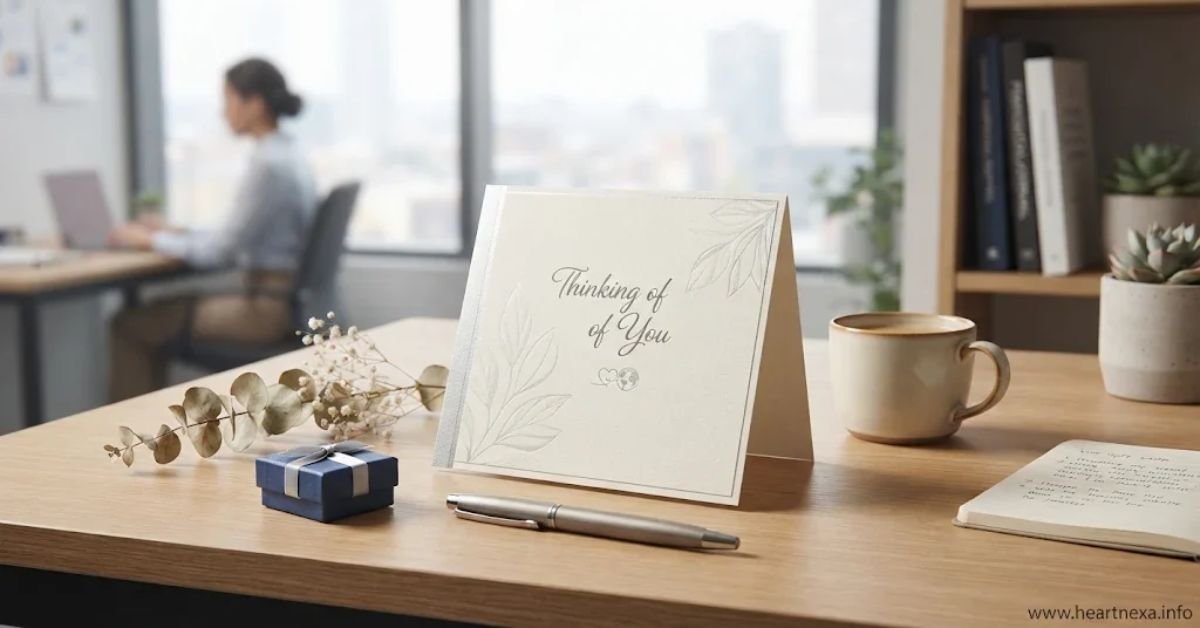
Work relationships need a lighter, more careful touch. The goal is warmth without overfamiliarity. A good professional check-in is brief, mentions something work-adjacent or human, and never makes the person feel they owe you a favor or a reply.
These messages suit a coworker on leave, a former colleague, a manager, a mentor, or a client you’ve built a real relationship with. If you’re writing to a client or senior contact, lean toward the more formal options and skip emojis and nicknames.
- The former colleague check-in. “I was thinking about our old team today and wanted to say hello. Hope all is well with you and the new role.” [Open door]
- The colleague on leave. “Thinking of you while you’re away, and hoping all is well. Nothing needed from you, just wishing you a restful time.” [No reply needed]
- The after-a-tough-stretch message. “That last project was demanding, and I wanted to say I appreciated your effort. Hope you’re getting a chance to recharge.” [No reply needed]
- The mentor message. “I was reflecting on advice you gave me a while back, and it’s still serving me well. Thinking of you and hoping all is well.” [No reply needed]
- The client relationship message. “I hope all is well on your side. I was thinking of our work together and wanted to check in. No agenda, just good wishes.” [Open door]
- The remote teammate message. “Hope all is well in your part of the world. It’s been a busy stretch, and I wanted you to know I’m thinking of you.” [No reply needed]
- The returning-to-work message. “Welcome back, and thinking of you as you settle in. Hope all is well and the transition is smooth.” [No reply needed]
- The manager-to-team message. “Just a note to say I’m thinking of you and hoping all is well. If anything is weighing on you, my door is open.” [Open door]
One practical point: if you’re checking in on someone who has been ill or is dealing with a personal matter, keep the message about them as a person, not about work. Avoid mentioning deadlines or pending tasks in the same message.
Thinking of You Messages for Someone Going Through a Hard Time
This section isn’t about condolences or get-well wishes. It’s for the person who is in a rough patch you may only partly know about: a stressful job, a strained relationship, a long period of uncertainty. They don’t need advice or silver linings. They need to know someone is thinking of them.
Three principles help here. Don’t try to fix anything. Don’t ask for details they haven’t offered. And don’t set a deadline on their response. The most useful messages say “I’m here” and then get out of the way.
- The no-pressure presence. “I’ve been thinking of you and hoping all is well, or that it gets easier soon. You don’t have to reply. I’m here whenever you want to talk.” [No reply needed]
- The “no fixing” message. “I don’t have the right words, and I’m not trying to fix anything. I just want you to know you’re on my mind.” [No reply needed]
- The practical offer. “Thinking of you. I’m making dinner this week and would love to drop some off. Just say the word, or I can leave it on your porch.” [Invitation]
- The patience message. “Take all the time you need. I’m thinking of you, and there’s no deadline on talking when you’re ready.” [No reply needed]
- The remembering message. “I know things have been heavy lately, and I wanted you to know you’re not forgotten. Thinking of you and hoping all is well soon.” [No reply needed]
- The shared-quiet message. “No need to talk. If you ever want to sit together or take a walk, I’m happy to just be there.” [Invitation]
- The strength-without-pressure message. “You’ve handled so much with more grace than you give yourself credit for. Thinking of you, and hoping you’re being kind to yourself.” [No reply needed]
- The follow-up message. “Checking in again, because I haven’t stopped thinking of you. No need to respond. Hope all is well, or getting there.” [No reply needed]
Notice the follow-up in message 8. A second or third check-in is often more valuable than the first, because support tends to fade after the initial wave of attention. If you can, send another message a few weeks later.
If someone has shared anything suggesting they might harm themselves, a thinking-of-you text isn’t enough. Reach out directly, and encourage them to contact a crisis line or a professional.
Hope You’re Safe and Well: Messages After a Storm or Bad News
When something big happens where a friend or relative lives, such as a storm, flood, earthquake, or a major news event, “hope all is well” takes on a more urgent meaning. You’re really asking whether they’re safe. This is also where tone matters most, because the person may be exhausted, without power, or short on phone battery.
Three habits help. Lead with concern, not curiosity, so don’t ask for details of what happened. Make it clear they don’t need to answer quickly, since a reply may drain a dying battery. And if you can offer something concrete, like a spare room or a call later, say so.
- The safety check. “I saw the news from your area and wanted to check in. Hope you and your family are safe. A quick ‘ok’ is all I need, and nothing more until you’re ready.” [Open door]
- The low-battery message. “Thinking of you and hoping you’re safe and well. Don’t spend your battery replying. I’ll just assume no news is okay until I hear otherwise.” [No reply needed]
- The practical offer. “Hope you’re all safe. If you need a place to stay, a charger, or anything else, tell me and I’ll sort it out.” [Invitation]
- The time-zone message. “Just woke up to the news and went straight to thinking of you. Hope all is well and everyone’s safe.” [Open door]
- The after-the-storm message. “I hope the worst has passed and you’re getting some rest. Thinking of you, and ready to help with cleanup or anything else.” [Invitation]
- The later check-in. “It’s been a little while since the news, and I’m still thinking of you. Hope things are settling and you’re looking after yourself.” [No reply needed]
Message 6 matters more than it looks. Attention fades quickly after a news cycle ends, but the aftermath for the people affected often lasts weeks or months. A second message once the headlines are gone tells them you haven’t forgotten.
Funny and Lighthearted Thinking of You Messages
Humor is one of the easiest ways to make a check-in feel natural, especially with people who don’t love sentimentality. It also lowers the stakes: a joke is easy to answer, and the person can reply with one of their own.
Two cautions. Humor works best when it matches the person’s actual sense of humor, so skip jokes about topics they’re sensitive about. And it isn’t the right tone if you know they’re going through something painful. In that case, use the previous section instead.
- The brain-has-been-busy message. “My brain has been running a slideshow of your best moments all week, and I figured I should let you know. Hope all is well.” [Open door]
- The unsolicited-update message. “This is an unsolicited wellness check from someone who keeps thinking of you. Please confirm that you are alive, thriving, and still funny.” [Open door]
- The snack message. “I just ate something that reminded me of the snacks we always argued about. Thinking of you, hoping all is well.” [Open door]
- The group-chat-that-died message. “Our group chat has been quiet for so long that I’m worried it’s gone to a farm upstate. Hope all is well with you.” [Open door]
- The “no agenda” message. “I have no news, no favors to ask, and no meme worth sharing. I’m just thinking of you and hoping all is well.” [No reply needed]
- The awkward-timing message. “I know the timing of this text is random, but so is most of my brain. Thinking of you, hope all is well.” [No reply needed]
- The pet-update message. “My cat looked at me with the same face you make when you disagree, and I thought of you instantly. Hope all is well.” [Open door]
- The overdue-hello message. “Consider this a very late hello, delivered with great sincerity and zero excuses. Thinking of you and hoping all is well.” [Open door]
A practical test: if you’d feel nervous watching the person read the message, tone it down. Funny works because it feels easy, and the best jokes in this category come from a real shared experience rather than a generic line. Swap in the specific detail, whether that’s the snack, the cat, or the old group chat, and the message becomes yours.
Thinking of You Card and Handwritten Note Messages

A card or handwritten note carries a different kind of weight than a text. It takes effort, it arrives without a notification, and it can be kept on a shelf or in a drawer. That permanence is the point: people tend to hold on to handwritten words in a way they rarely do with messages on a screen.
Because the person can reread a card, aim for lines that hold up on a second and third reading. Avoid anything time-sensitive (“see you tomorrow”) and favor feelings that stay true. Keep the note short enough to fit the card without squeezing, and sign it with your real name or the name they know you by.
- “Just a quick note to say you’ve been in my thoughts. Hope all is well, and I’m sending warmth your way.” [No reply needed]
- “I was sorting through old photos and found one of us laughing. I’m glad to know you. Thinking of you and hoping all is well.” [No reply needed]
- “This card is small, but the thought behind it is big: you matter to me, and I’m wishing you well.” [No reply needed]
- “No news, no agenda, just a hello on paper. Thinking of you and hoping your days are gentle.” [No reply needed]
- “Sometimes a text feels too quick for what I want to say. So, a card: I’m thinking of you, and I hope all is well.” [No reply needed]
- “Thinking of you this season and hoping your home is full of warmth. Hope all is well.” [No reply needed]
- “You’ve been on my mind more than you know. I hope this finds you well and a little bit cheered.” [No reply needed]
- “I’d love to hear from you if you feel like writing back, but please don’t feel you have to. Thinking of you and hoping all is well.” [Open door]
A few finishing touches make a card feel more personal. Add one handwritten sentence beyond the printed message, even if it’s just a memory. Mention something specific, like a place or a nickname. And if you’re sending to an older relative or someone who lives abroad, check the address and allow extra delivery time, so the card doesn’t arrive late and miss its moment.
How to Write Your Own Thinking of You Message (The Light-Touch Formula)
Copying a message from a list is fine, but a message with a few of your own words in it almost always lands better. The Light-Touch Formula below is a simple way to build one in under a minute. It has three parts, and each one does a specific job.
Anchor, Warmth, No-Pressure Close
Anchor is one concrete detail that proves the message is really about them: a place, a song, a shared joke, a nickname, a dish. Without it, “thinking of you” can read as a template.
Warmth is one feeling, stated plainly. Pick a single word or phrase, such as “glad,” “grateful,” “proud,” or “missing you.” Stacking several feelings makes a message sound like a greeting card.
No-Pressure Close is the last line, and it decides how the reader feels about replying. “No need to answer” frees them. “Hope all is well” leaves a door open. “Free for a call Sunday?” makes a real request.
Here is the formula applied to the same relationship, an old college roommate:
| Part | Example |
| Anchor | “Heard a song from our dorm playlist at the grocery store today.” |
| Warmth | “It made me really miss those years.” |
| No-Pressure Close | “Thinking of you and hoping all is well. No rush to reply.” |
Put together, it reads: “Heard a song from our dorm playlist at the grocery store today, and it made me really miss those years. Thinking of you and hoping all is well. No rush to reply.” That’s three short sentences and about thirty words.
If you get stuck, write the anchor first. Once you have a real detail, the other two parts tend to follow without effort.
The Reply-Pressure Ladder
Every message you send sits on a ladder of how much response it asks for. Choosing the rung on purpose avoids the two most common problems: leaving someone with an obligation they didn’t want, or sending something so closed that the conversation can’t start.
| Rung | What it sounds like | Best for |
| 1. No reply needed | “No need to answer, just thinking of you.” | People who are busy, struggling, or distant |
| 2. Open door | “Hope all is well. How have you been?” | Friends and family you’d happily hear from |
| 3. Invitation | “Free for a call this weekend?” | Relationships you want to actively rebuild |
Moving up the ladder is easy. If someone replies warmly to a rung-1 message, you can follow with a rung-2 or rung-3 message later. Moving down is harder, since a direct request can’t be unsent. When you’re unsure how welcome you’ll be, start low.
The ladder also works in reverse. If you’ve been the one who hasn’t replied to a message for a while, a rung-2 answer such as “Thank you for this, it made my day. How are you?” restarts things without requiring a long explanation.
Is It Weird to Send a Thinking of You Message Out of the Blue?
No. In almost every ordinary case, it isn’t weird, and the evidence suggests the person on the receiving end will be more pleased than you expect.
The most solid support comes from a peer-reviewed study, “The Surprise of Reaching Out: Appreciated More Than We Think” by Peggy Liu, SoYon Rim, Lauren Min, and Kate Min, published in the Journal of Personality and Social Psychology (2023, vol. 124, issue 4). Across a series of experiments with more than 5,900 participants, people who reached out consistently underestimated how much the recipient would appreciate it. The researchers’ explanation is surprise: recipients focus on the pleasant surprise of hearing from you, while senders focus on how the message might look.
Two details from the research are especially useful if you’re hesitating:
- The effect was strongest for surprising contact. The underestimate grew when the message was more unexpected or when the tie was weaker. In other words, the longer the gap and the looser the connection, the more your hesitation is probably misplaced.
- A simple check-in was enough. The researchers described reaching out as getting in touch to show you’re thinking of someone, and brief texts counted. You don’t need a grand gesture.
One limitation: the findings rely on self-reported feelings, and the authors note that questions about different cultures and long-term effects remain open. Treat the study as a strong reason to stop second-guessing, not a guarantee about any single person.
When to Hold Off
A few situations call for more care, even if the general rule holds:
- An ex-partner. A message after a breakup can reopen a door you may not mean to open. Unless you’re genuinely on friendly terms, think about the reason first.
- Someone who asked for space. If they’ve said they don’t want contact, respect it.
- A pattern of unanswered messages. One check-in is kind. A string of messages with no reply starts to feel like pressure, and it’s time to pause.
Outside those cases, the practical advice is simple. Send it, keep it short, choose the lowest rung of the Reply-Pressure Ladder if you’re unsure, and let them respond when they’re ready.
What Not to Say in a Thinking of You Message
Most mistakes in a check-in message come from good intentions. Someone wants to sound warm and ends up sounding accusing, vague, or demanding. The six habits below are the ones that most often turn a kind message into an awkward one.
Blaming the Silence
“I haven’t heard from you in a while” can seem innocent when you type it. To the reader, it can feel like a charge sheet, as if the gap were their fault. Hallmark’s card-writing advice makes the same point: don’t blame the recipient for losing touch, even by accident.
Swap it for a version that owns your side or simply skips the topic. “It’s been a while, and I’ve been thinking of you” says the same thing without assigning fault.
Over-Apologizing
A brief apology for going quiet is fine. A paragraph of guilt isn’t, because it makes the reader responsible for reassuring you. One light line, such as “I’m sorry I’ve been quiet,” then move on to them.
The Vague “We Should Catch Up”
This phrase feels friendly and rarely leads anywhere. It makes no request, so there’s nothing to say yes to. If you do want to talk, offer a concrete option: “Free for a call Sunday afternoon?” Even if the answer is no, you’ll get an answer.
Fishing for Reassurance
Lines like “I guess you’ve forgotten about me” put the other person on the defensive. If you’re hurt by the distance, a calm, direct message works better than a hint: “I’ve missed talking with you. Would you want to catch up soon?”
Stacking Questions
Three questions in one text (“How are you? How’s work? Are you still in the same place?”) can feel like a form to fill out. Ask one. If they reply, the rest will follow naturally.
Treating “Thinking of You” as a Cover for Something Else
If you’re really writing to ask a favor, to reopen an argument, or to test whether someone still cares for you romantically, say so honestly. A warm opening followed by an unrelated ask tends to feel like a bait and switch, and it makes the warm part feel insincere in hindsight.
One more small habit: avoid copying and pasting the same message to many people. People can usually tell, and a generic “hope all is well” loses its warmth quickly. Even a single changed word, such as a name or a detail, keeps it personal.
Text, Card, Email, or Voice Note: Which Fits Best?

The channel is part of the message. The same sentence can feel breezy in a text, formal in an email, and deeply personal on a handwritten card. Choosing well is mostly a matter of matching the person’s habits and the weight of what you want to say.
| Channel | Best for | Watch out for |
| Text (iMessage, SMS, WhatsApp) | Friends, family, and anyone you already text; light, low-pressure check-ins | Feels abrupt for someone you haven’t spoken to in years or who rarely texts |
| Card or handwritten note | Older relatives, big gaps, hard times, or when you want it kept | Slow delivery; can feel heavy if the relationship is casual |
| Former colleagues, professional contacts, people abroad who prefer email | Easily buried; can read as formal or like a work message | |
| Voice note | Close friends, long-distance family, anyone who’d enjoy hearing your voice | Can feel like an obligation to reply in kind; not ideal for people in loud or busy settings |
| Social media message | Someone whose number or address you don’t have | Might land in a hidden requests folder; some people rarely check |
A few practical rules sit behind the table.
Follow their lead. If someone always replies by voice note, send one. If their last three messages were one-word texts, a long email may feel out of step. Look at how they’ve reached out to you and mirror the rhythm.
Raise the effort when the stakes rise. A routine check-in suits a text. A message during a hard stretch, or after years of silence, often deserves a card or a call, because the extra effort signals care. Even sending a card and following with a short text a few days later works well.
Think about the reader’s moment. A voice note is lovely over a quiet evening and awkward for someone in a meeting. A text can be answered whenever it suits them. If you’re not sure, the text or card lets them respond in their own time.
Don’t let the channel become the barrier. If you’re hesitating because you can’t decide between a card and a text, send the text now. A short message today is better than a perfect card that never gets mailed.
How to Reply When Someone Sends You a Thinking of You Message
Receiving one of these messages can be oddly hard to answer. You may feel guilty about a long silence, unsure how much to say, or tired and short on words. The good news is that a reply doesn’t need to be long or perfect. It only needs to be warm and honest.
Three principles help. Reply when you can, even if it’s late, since a late “thank you” is far better than none. Match the other person’s effort rather than exceeding it. And skip the long apology for the delay, since a brief acknowledgment does the job.
Here are six replies, matched to different situations:
- The simple thank-you. “This made my day. Thank you for thinking of me.” Works for almost anyone, and needs no follow-up.
- The reciprocal reply. “I’m so glad you reached out, and I’ve been thinking of you too. How have you been?” Opens the conversation if you want to continue it.
- The late reply. “Sorry for the slow reply. Your message really meant a lot, and I didn’t want to answer with something rushed. I’d love to catch up properly.” Short apology, then warmth.
- The low-energy reply. “Thank you for this. I’m having a tough stretch and don’t have much energy, but your message helped. I’ll be in touch when I can.” Honest, and gives them a clear picture without requiring details.
- The invitation reply. “Hearing from you was a lovely surprise. Are you free for a call this weekend? I’d love to hear all about it.” Moves things up the Reply-Pressure Ladder if you want to reconnect.
- The gentle-boundary reply. “Thank you for the kind message. I appreciate it, though I’m not looking to reconnect right now. I wish you well.” Polite and clear, for situations where you’d rather keep distance, such as with a former partner.
If the message arrived during a hard time for you, you don’t owe an explanation. A simple “thank you, it meant a lot” is enough. And if you’re the type to let replies slide, try answering within a day or two while the warmth is fresh, even with just a heart or a few words. You can follow up properly later.
Thinking of You vs. Miss You vs. Get Well Soon
These three phrases overlap, and search results often mix them together. They do different jobs, though, and picking the wrong one can send the wrong signal. A quick way to see the difference is to ask what each phrase assumes about the other person’s situation and about your feelings.
| Phrase | What it says | What it assumes | Typical use |
| Thinking of you | You’re on my mind, with no ask attached | Nothing specific; works in good times and bad | General check-ins, hard stretches, no-reason hellos |
| Miss you | I feel your absence | A closeness, and often a gap you’d like to close | Friends, family, and partners you want to see more |
| Get well soon | I hope your health improves | The person is ill or recovering | Illness, surgery, injury |
Thinking of You
This is the most flexible of the three. It works whether the person is thriving or struggling, and it asks for nothing. That’s why it suits the “hope all is well” check-in: it says you care without naming a problem or a request.
Miss You
“Miss you” is warmer and more direct, and it carries a bit of longing. As Hallmark’s writing tip puts it, a bare “miss you” can feel a little sad on its own, but it works well as a lead-in to a plan like “let’s talk” or “let’s get together.” Use it when you want to move toward contact, not just signal goodwill. It can feel heavy with someone you don’t know well, or with an ex.
Get Well Soon
This one is specific to health. It assumes an illness or injury, so sending it as a general check-in can confuse the reader or make them wonder what you’ve heard. If someone is unwell, you can combine the two: “Thinking of you and hoping you’re feeling better” is warm without being clinical.
One related point on health: if you’re not sure whether the person is ill, “thinking of you” is the safer choice. It doesn’t presume anything, and it leaves them free to tell you as much or as little as they like.
Better Ways to Say “Hope All Is Well” in Emails
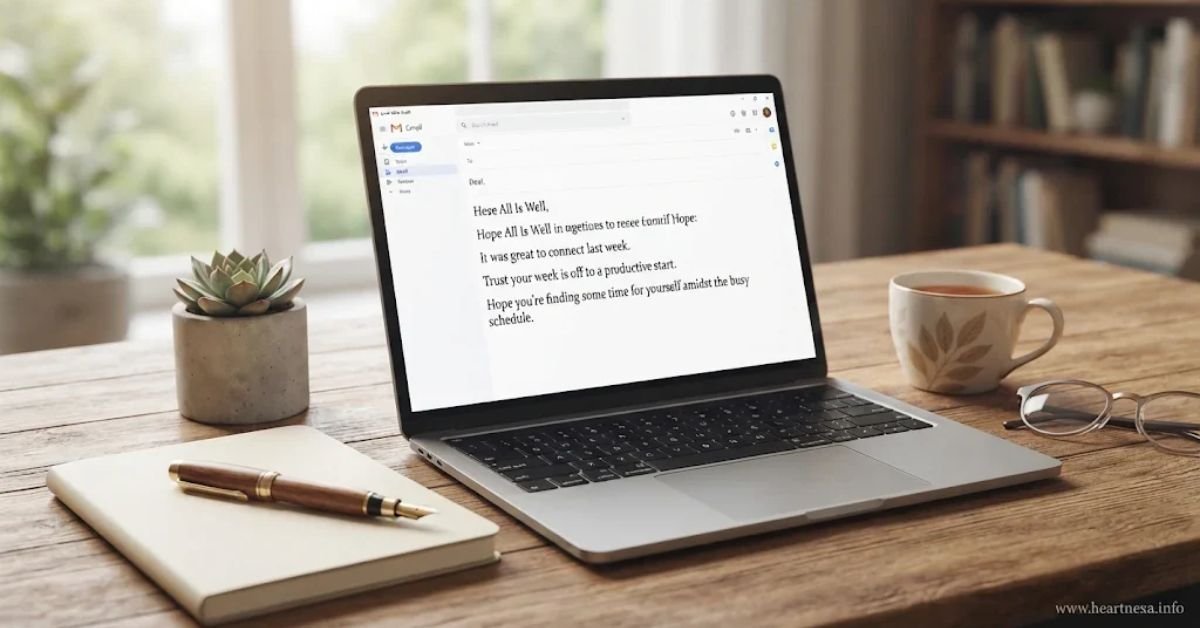
“Hope all is well” is one of the most common email openers there is, and that’s the problem. HubSpot’s sales team has pointed out that a large share of the emails they receive begin with a version of it, which makes the phrase easy to skim past. It isn’t wrong. It just carries little warmth by the time it reaches the reader.
This matters for the personal messages in this article too. A check-in that sounds like a template feels like a template, so the fix is the same as in the Light-Touch Formula: add something specific.
Why the Phrase Gets Ignored
When a line appears in thousands of emails, readers stop registering it. It also tends to be followed by an immediate ask, which teaches people to read it as a warm-up for a request. In a personal message, that can undercut the sincerity you meant.
Alternatives That Sound More Human
The swaps below depend on context, so use the one that matches your relationship.
| Instead of | Try | Why it works |
| “Hope all is well.” | “I hope your week is off to a good start.” | Anchors to a specific moment |
| “Hope this email finds you well.” | “I’ve been thinking of you and wanted to say hello.” | Replaces a formula with a reason |
| “Hope you’re doing well.” | “How are things going with [project, move, new job]?” | Shows you remember their life |
| “Hope all is well with you and your family.” | “I hope [name] and the kids are doing well.” | Names people, which feels personal |
| “Hope all is well.” (to a distant contact) | “Hope the winter isn’t treating you too harshly.” | A small shared detail, like weather or season |
A few cautions apply. Weather and seasonal references only work when they’re true for the reader, so check where they live. Names and details should come from real memory, not guesswork, since a wrong detail is worse than none. And in formal professional settings, a plain “I hope you’re well” is still perfectly acceptable. Use the swaps when you want warmth, and keep the classic line when you want to stay conventional.
For personal check-ins by email, a good test is whether you could send the first line to anyone. If you could, rewrite it until it could only be sent to this one person.
FAQ’s
What do you say when you’re thinking of someone?
Keep it short, warm, and specific. A message like “Thinking of you today and hoping all is well” works for most people. Add one real detail, such as a shared memory or an inside joke, and it feels personal instead of generic.
Is it okay to send a “thinking of you” text out of the blue?
Yes, in nearly all cases. A peer-reviewed study in the Journal of Personality and Social Psychology found that people underestimate how much others appreciate being reached out to. Hold off only if the person has asked for space or the contact would reopen a painful situation, such as with an ex.
What should I text someone I haven’t talked to in a long time?
Acknowledge the gap lightly, share one warm memory, and keep the ask small. For example: “It’s been a while, but I was thinking of you and hoping all is well. How have you been?” Avoid blaming language like “I haven’t heard from you.”
Does “thinking of you” mean you miss someone?
Not necessarily. “Thinking of you” is a softer, more flexible phrase that says someone is on your mind without implying longing. “Miss you” is more direct and usually signals you’d like more contact. If you want to stay low-key, choose “thinking of you.”
How do I say “thinking of you, hope all is well” in a short text?
Try “Thinking of you. Hope you’re well.” or “Hope all is well! Thinking of you.” Both are quick to read and ask for nothing in return. If you want to invite a reply, add a single easy question, such as “How’s your week going?”
How should I respond to a “thinking of you” message?
A simple “Thank you, this made my day” is enough. If you’d like to talk more, add “I’ve been thinking of you too. How are you?” If you’re late replying, a brief apology followed by warmth works better than a long explanation.
What’s the difference between “thinking of you” and “get well soon”?
“Get well soon” is specific to illness or injury, while “thinking of you” fits any situation. If you aren’t sure whether someone is unwell, “thinking of you” is the safer choice because it doesn’t assume anything about their health.
Is “hope all is well” too formal or overused?
It’s polite and widely understood, but it appears so often in emails that it can feel like filler. In personal messages, pairing it with a specific detail keeps it warm. In formal contexts, it remains perfectly acceptable.
Conclusion
Thinking of you, hope all is well messages work because they’re small. One honest sentence, a single real detail, and a door left open can do more than a long paragraph. The 105 messages above are starting points: change a word, add a memory, and they become yours.
If you remember only a few things, remember these. Anchor the message in something specific, keep the ask as light as the relationship allows, and don’t wait for the perfect moment. The research on reaching out suggests that the person on the other end is more likely to be glad than bothered, so the hesitation is usually the biggest obstacle.
Pick one person who has been on your mind lately and send them a message today. They may be quietly hoping to hear from someone, and a short, sincere note might be the best part of their day.

Creating heartfelt wishes, greetings, and inspiring messages to help you celebrate special moments, spread positivity, and express your feelings beautifully.